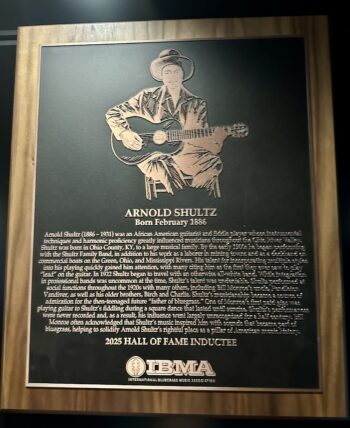
Arnold Shultz
Biography
Arnold Shultz was an African-American musician whose blues-driven guitar playing and, to a lesser extent, fiddle work profoundly influenced the development of bluegrass music. Despite his immense talent, Shultz never recorded his music and is known today only through oral histories and the legacy of those he inspired. Much of that legacy today rests on statements by Bill Monroe, who credited Shultz for inspiring the inclusion of the blues in bluegrass.
Arnold Shultz was born in February 1886 in the Cromwell precinct of Ohio County, Kentucky. He was the eldest child of David Shultz, a former slave born in 1844, and Elizabeth Shultz, who was born free. His father had taken the surname of his owner, a Revolutionary War soldier who had settled in Ohio County. Arnold grew up in a musical family, where stringed instruments were a common presence. His cousins and siblings were also musically inclined, and the family often performed together as the Shultz Family Band.
By the age of 14, Arnold was already working in the coal mines alongside his father, a common occupation in Ohio County at the time. Despite the grueling labor, Shultz found time to learn the guitar and fiddle, primarily from his relatives. The 1900 census indicates that Shultz could read and write, suggesting he had some formal education. After mastering music basics from family, most of his musical training was self-taught.
The Shultz Family Band was a local fixture in Ohio County, playing “hillbilly music” at dances, picnics, and other community events. The band included Arnold on guitar, Ella Shultz Griffin on fiddle, Luther Shultz on bull bass fiddle, and Hardin Shultz on banjo. Ella, Arnold’s cousin, recalled that Arnold had been playing music since childhood and had an innate ability to master multiple instruments without formal training.
The band primarily performed in Ohio County, occasionally traveling to nearby towns like Rosine. Their music was deeply rooted in the traditions of the region, blending elements of folk, blues, and early country. Arnold’s guitar playing stood out for its complexity and innovation, even in these early years.
Shultz built a reputation as an innovative, versatile musical stylist whose stamina and energy in a band could keep a crowd dancing all night and into the morning. He performed with his own groups, including exceptional Black musicians such as mandolin player Walter Taylor, as well as local professional ensembles such as the traditional jazz band of white drummer Forrest “Boots” Faught (1902-1981). In part because of the inclusive hiring practices in the mines, social separation of Black and white members was not as rigidly observed in Western Kentucky communities as in other parts of the South—especially when it came to music. Though sometimes a source of tension, integrated bands and mixed-race jam sessions were by no means uncommon, often leading to fertile artistic exchange.
Tex Atchison (1912-1982), of Rosine, Kentucky, who later became the fiddler and lead vocalist with the Prairie Ramblers in Chicago, was impressed by Shultz’s playing as a young man. The Everly Brothers’ grandfather, living in nearby Brownie, once hired Shultz to teach an especially challenging guitar number to his daughter, Hattie.
By the late 1920s, Shultz was playing regularly with Pendleton Vandiver (1869-1932), Bill Monroe’s beloved “Uncle Pen.” Through Vandiver, Shultz met Monroe, still in his teens. The gifted youngster gained some of his earliest experience as a musician performing with Shultz. Like other musicians, Monroe was struck by Shultz’s skillful use of chords that expanded expressive harmonies beyond the familiar I-IV-V on guitar, as well as his occasional use of a knife-blade in what would now be called a “slide” or “bottleneck” style. In addition, the breadth of Shultz’s repertoire and its appeal to audiences impressed the younger musician. Old-time fiddle tunes, blues, jazzy numbers and jug band ditties—perhaps picked up by Shultz in his occasional travels as a riverboat deckhand—all found a place in Monroe’s musical landscape.
Monroe later reflected on Shultz’s impact, stating, “There’s things in my music, you know, that come from Arnold Shultz—runs that I use a lot in my music. I don’t say that I make them the same way that he could make them ‘cause he was powerful with it.” Monroe also acknowledged that had he not taken up the mandolin, he might have become a blues guitarist, inspired by Shultz’s playing.
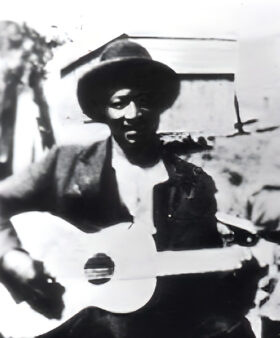
Shultz was described as a short, slightly overweight man who often wore a big black hat. He was quiet and reserved but personable when spoken to. Despite the racial segregation of the era, Shultz was able to cross racial lines through his music. White audiences and musicians in Ohio County welcomed him into their homes and events.
Arnold Shultz died on April 14, 1931, in Morgantown, Kentucky, at the age of 45. His death certificate listed the cause as a mitral lesion, a heart condition, but family members believed he was poisoned by jealous musicians who spiked his whiskey. He was buried in an unmarked grave in Morgantown’s black cemetery, and his death went largely unnoticed at the time. The slight was corrected in 1994 when a marker was erected at his gravesite.
Although no recordings of Arnold Shultz have been recovered, he was far from obscure in his region. In a locale noted for remarkable musicians—then as now—he was a standout, remembered with respect and affection decades after his death in 1931. Like the original Carter Family, his musical career predated the emergence of bluegrass music as a distinctive genre. Nevertheless, his place in the history of the music is secure.
Erika Brady is a retired professor of folklore, Bowling Green State University.
Gary Reid is a bluegrass music historian, journalist, producer, and actor based in Roanoke, Virginia.